 Needlepoint Maker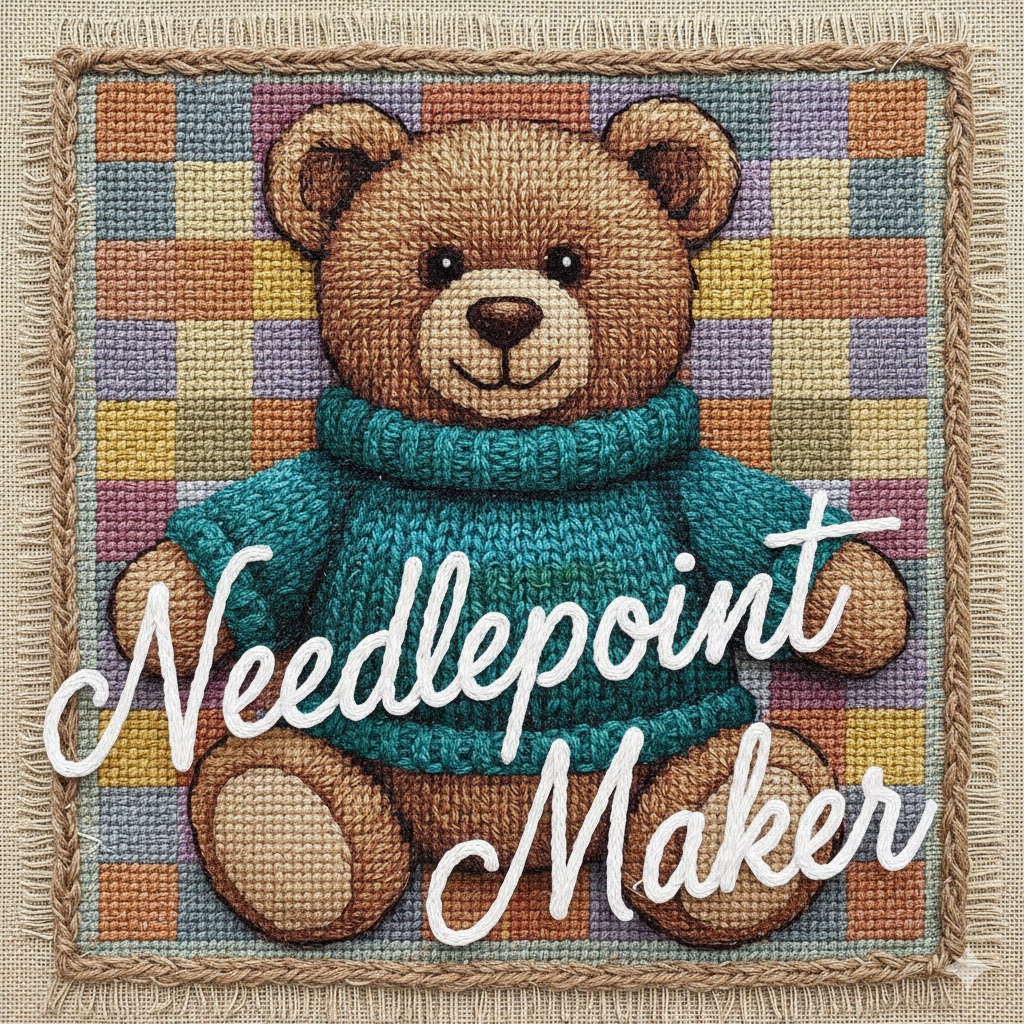
Why this photo converts well
The subject is centered, the crop is already square, and the dark bear separates from the lighter background. The face and ears remain recognizable at a small size. Those broad shapes do most of the work before palette refinement begins.
The fine lettering and small decorative marks are the difficult areas. At 72 stitches wide, some strokes become only one square thick. They are the first details to inspect after conversion.
Choosing 72 stitches at 18 mesh
A 4-inch square at 18 mesh is 72 stitches in each direction. That produces 5,184 total stitches. It is enough resolution to describe the bear's face and round outline while staying within a common small-project size.
On 12 mesh, a 4-inch square would contain only 48 × 48 stitches. That version would work up faster, but the lettering and facial marks would need more simplification. Keeping the 72-stitch chart and switching it to 12 mesh would instead create a 6-inch square.
Using 30 colors as a review point
The tested conversion produced 30 colors. That preserves many tonal changes in the illustration, but it is not automatically the final stitching palette. The next step is to review the color legend for near-duplicates and colors used by only a few isolated stitches.
For a calmer project, reduce the maximum color count and compare the bear's eyes, muzzle, outer edge, and lettering. If those important shapes survive, fewer colors will usually be easier to stitch.
What to clean up manually
- Merge isolated background squares that do not support an edge.
- Keep enough contrast between the face, muzzle, and eyes.
- Inspect one-square letter strokes and decide whether to thicken or remove them.
- Smooth the round outer edge only where a jagged square interrupts the silhouette.
- Avoid polishing texture that will not be noticeable at the finished size.
Export and stitching plan
The grid image is the primary visual chart, while the legend CSV records the color codes and stitch counts. The preview PNG is useful for judging the overall image without grid lines. Once stitching begins, the saved browser project can mark individual squares complete and track progress through all 5,184 stitches.
Lesson from this example: a strong silhouette and deliberate crop matter more than preserving every texture. Use extra colors for identifying details, not simply because the source photo contains them.